
In this new chapter of “The Art of Diamond Craftsmanship Revealed”, we invite you inside the Rubel & Ménasché laboratory. Here, you will discover a mysterious world where high-tech equipment and experts work in tandem, conducting analyses that are as thorough as they are impressive.
A hushed, dimly lit atmosphere greets visitors as they step almost silently into the Rubel & Ménasché laboratory, a space that was modernized and expanded to 40 square meters in 2024.
Here, you will learn how diamonds are screened to verify their natural origin, an essential step before each stone continues its journey through the Maison. Fully traceable from the moment of purchase from sightholders (Rubel & Ménasché has been a partner of Dali Diamond, a De Beers’ sightholder since 1969) through to shipment to the workshops of Place Vendôme, every stone undergoes meticulous, documented verification. A team of analysts and gemologists, supported by some of the most advanced equipment on the market, examines each diamond as soon as it enters the Maison.
“This transparency regarding our analytical procedures is an essential guarantee of trust for our clients,” says Nastasia, Head of Quality Control and Gemstone Expertise.
State-of-the-Art Equipment
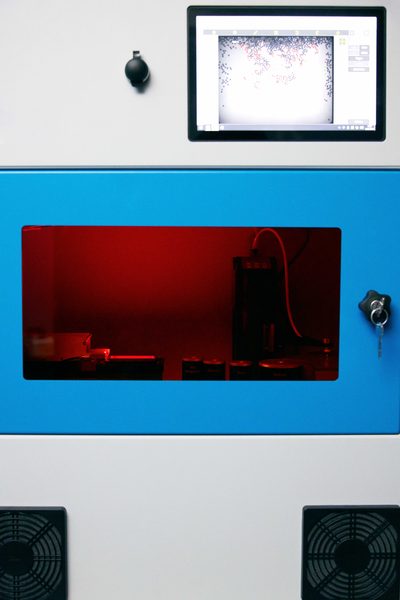
In the purpose-built analytical laboratory, nine state-of-the-art machines, most of them Swiss-made, including two ASDI-500 systems, can analyze up to 200,000 stones in a single day and detect any stone that does not belong, even one as small as a grain of sand.
This extensive investment in equipment enables Rubel & Ménasché’s in-house laboratory to carry out all the analyses required before delivering diamonds to clients.
Verification at Every Stage
“Every stone we receive, even if accompanied by a grading report from an external laboratory, is re-examined by Rubel & Ménasché’s in-house laboratory. Each verification stage is recorded in our internal software, allowing us to trace the complete history of every parcel, including the name of each person who handled it, the date, the time and the work carried out on the stones. A specific color-coding system identifies each parcel’s position in the workflow: red for goods that have not yet been checked, yellow when the analyzed stones have been identified as natural, and green once sorting, according to the four diamond grading criteria (the 4Cs: cut, clarity, color and carat weight) has been completed. Each parcel of diamonds carries its own label. In a sense, this is its ‘identity card,’ which is progressively updated as it moves through the Maison’s internal processes,” Nastasia explains.
Natural Origin Revealed Through Luminescence
Nastasia likes to point out that “natural diamonds, which have spent millions of years beneath the Earth’s surface, tell their story through their ‘imperfections’ (chemical impurities and internal structure). Lab-grown diamonds, by contrast, having grown in just a few weeks in a controlled environment, have a far less eventful history.”
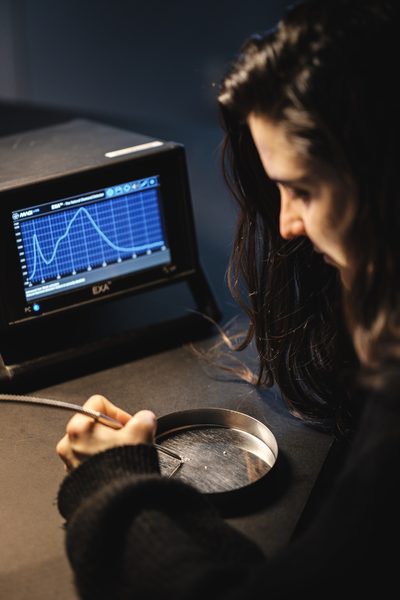
Determining whether a diamond is natural is primarily achieved through photoluminescence, by analyzing the presence or absence of point defects in its crystal structure. These defects become apparent during spectroscopic observation under laser excitation. When the diamond absorbs the laser light, it emits luminescence, predominantly blue. This emitted light is analyzed using a spectrometer, and the resulting data are then interpreted by an analyst.
Staying at the Forefront of Technology
Established in 2017 on Rue de la Paix in Paris, the laboratory was among the first to be set up within a diamantaire Maison. This pioneering position has encouraged Rubel & Ménasché to remain at the forefront of its field.
Demand for pavé-set jewelry is such that the laboratory has recently had to invest in automated equipment capable of determining the natural origin of diamonds with exceptional precision.
The ASDI-500 is indispensable in this respect and has already proved its effectiveness over nearly three years of operation in the laboratory. It can analyze and sort stones from just 0.5 mm in diameter. With a throughput of more than 700 stones per hour and extended autonomous operating capacity, it can run continuously, day and night without interruption, considerably improving the laboratory’s analytical performance and speed.
This detection capability is particularly important for Rubel & Ménasché, whose core activities include dealing in melee diamonds. The investment is substantial, but remaining at the cutting edge of technology is essential to reinforcing the Maison’s credibility and reliability in the eyes of its clients. Being recognized as a strong and reliable partner is one of the Maison’s fundamental values.
Automating Detection to Focus on What Matters Most
“Before we had all these automated machines, analysis was carried out entirely by hand,” Nastasia explains. “It was extremely time-consuming and required constant concentration. Today, analysts focus primarily on ‘refers,’ meaning stones flagged by automated systems as “requiring further investigation” and set aside. These stones often require more extensive analysis at what we call ‘low temperature.’ They are immersed in liquid nitrogen at −196°C to maximize spectral resolution, allowing more precise analytical results to be obtained. At this extremely low temperature, even the slightest laser energy applied to the diamond reveals its underlying characteristics, enabling us to determine whether it is of natural origin,” Nastasia emphasizes.
Sharing Knowledge to Drive Progress
Guaranteeing and safeguarding the natural origin of diamonds is not simply a challenge for one company, but for the entire industry. Ultimately, the credibility of the diamond supply chain as a whole is at stake. At Rubel & Ménasché, knowledge that can benefit everyone and help advance the profession must be shared. Stephan Wolzok, the Maison’s President, attaches great importance to this principle and is personally committed to it.
With this in mind, the laboratory has established a community of practice, sustained by ongoing exchanges with leading European laboratories. Given the scale of its operations (several hundred thousand diamonds per month) and its expertise in melee diamonds, the Maison is particularly well placed to share and promote its knowledge.
Alongside the time devoted to diamond analysis, the laboratory also conducts ongoing scientific monitoring. “Our field is constantly evolving, so we keep abreast of every discovery and leave no avenue unexplored, because any new information could advance our knowledge and analytical techniques,” Nastasia concludes.
Images: Rubel & Ménasché