
The theft of Queen Nazli’s necklace on August 27 from the MAK in Vienna, where it was on display, represents an immense loss. A treasure has vanished. A major piece in the history and heritage of Van Cleef & Arpels, the jewel was also a remarkable example of Art Deco white jewelry.
From the Egyptian Court to the Van Cleef & Arpels Archives
The story of the necklace known as the “Collerette,” which has now disappeared, is inextricably linked both to the excellence of French jewelry craftsmanship and to the fate of Egypt’s royal family. Created in 1939 for Queen Nazli of Egypt, it was worn by her in Cairo at the wedding of her daughter to the future Shah of Iran, Mohammad Reza Pahlavi.
Having lost her fortune in exile following the fall of the royal dynasty, the Queen sold the necklace at Sotheby’s in 1975, where it fetched $140,000. It then disappeared from the market for nearly 40 years before Van Cleef & Arpels bought it back at Sotheby’s New York in 2015 for an impressive $4.3 million. The Parisian jeweler celebrated the return to its heritage collection of this sumptuous piece, set with 673 diamonds totaling 200 carats and emblematic of the Maison’s style at the time.
A Major Work of Artistic Heritage
Back in the Maison’s collection, the “Collerette” was far more than a spectacular royal jewel. It stood as a living testament to Parisian Art Deco, the history of the Egyptian and Iranian royal courts, and the golden age of white jewelry, a late-1930s style that paired diamonds with platinum to create dazzling, monochromatic architectures of light.
On Queen Nazli’s necklace, brilliant-cut and baguette-cut diamonds come together in a composition defined by the rigorous geometry and symmetry typical of the period. Rows of diamonds form semicircular draped and ribbon motifs that sweep around a magnificent central stone. These motifs were echoed in the matching tiara created at the same time for the princess’s wedding ceremony.
In a painful twist of fate, the necklace was stolen just as Van Cleef & Arpels launched its Fascinations d’Égypte high jewelry collection, once again bringing the Maison’s rich Egyptian-inspired heritage, of which this necklace formed part, into the spotlight.
Heritage at Risk
The “Collerette,” which had already been the target of an attempted theft in France in 2021, was being shown in the exhibition “Glanzstücke: Van Cleef & Arpels High Jewelry & Masterpieces from the MAK Collection,” alongside approximately 300 other pieces from the Parisian Maison. It was taken by two thieves who entered the museum posing as ordinary visitors, struck the reinforced display case 41 times with a hammer, seized the jewel and then left without being stopped. Images of their faces captured by surveillance cameras were subsequently circulated internationally.
In Paris, where the French Crown Jewels were stolen from the Louvre in 2025, as in Vienna, these spectacular thefts highlight the vulnerability of museums to swift and violent operations of this kind. But while the Louvre jewels are difficult to dismantle given the diversity of their stones, the same is not true of Queen Nazli’s necklace, whose high-value diamonds could more easily be removed and dispersed. This would represent an incalculable loss, not only for the Van Cleef & Arpels collections but also for French cultural heritage.
The Return of the Grand Condé
Another jewel with an eventful history, the Grand Condé, a remarkable 9.01-carat pink diamond, will be on display starting October 17 at the Musée Condé at the Château de Chantilly, in partnership with L’École des Arts Joailliers.
Brought back from the Golconda region of India by Jean-Baptiste Tavernier on behalf of Louis XIV, this rare pink diamond has been documented in the collections of the Princes of Condé since the 18th century. With an even, slightly orangey pink color, corresponding today to Fancy Orangy Pink, it features an antique pear-shaped cut and is a Type IIa diamond, the category comprising the most chemically pure diamonds. The Grand Condé is one of the world’s most exceptional historic gemstones.
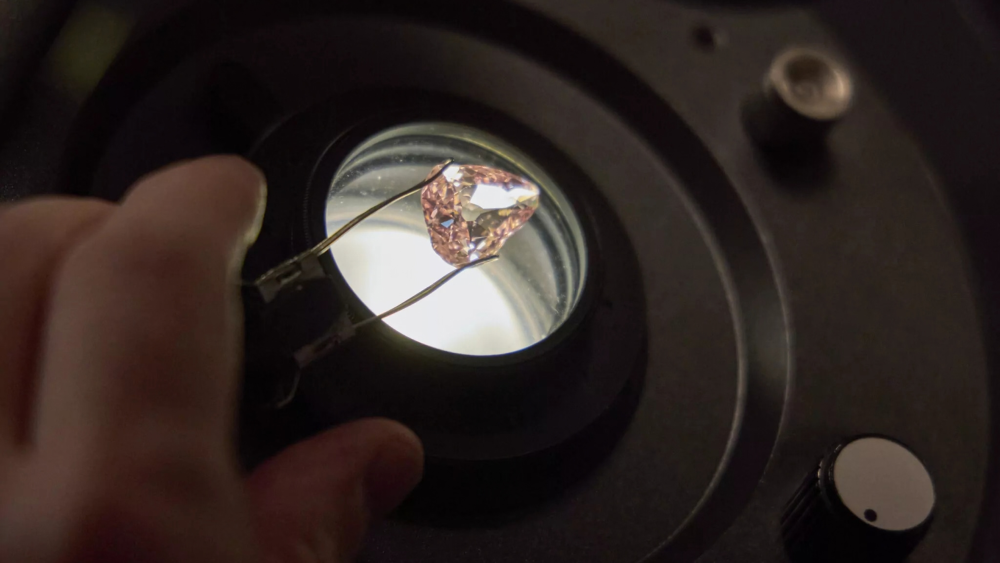
The stone itself was stolen from the Musée Condé in October 1926 before being quickly recovered, hidden inside an apple. Since then, it has been kept in the museum’s vault, with only a replica on display. From October through January 2027, the actual diamond will be brought out of the vault and exhibited. Its reappearance, exactly a century after the theft, will be accompanied by the results of new gemological analyses conducted by Emmanuel Fritsch, Professor Emeritus of Physics and gemologist at the University of Nantes, and Aurélien Delaunay and Annabelle Herreweghe, respectively Director and Deputy Director of the Laboratoire Français de Gemmologie.
Main image: Collerette, 1939. Platinum, diamonds. Van Cleef & Arpels Collection © Van Cleef & Arpels SA